
SmartFuture • 16 Feb 2026
What to Look for in Your Remote Patient Monitoring Solution in 2026
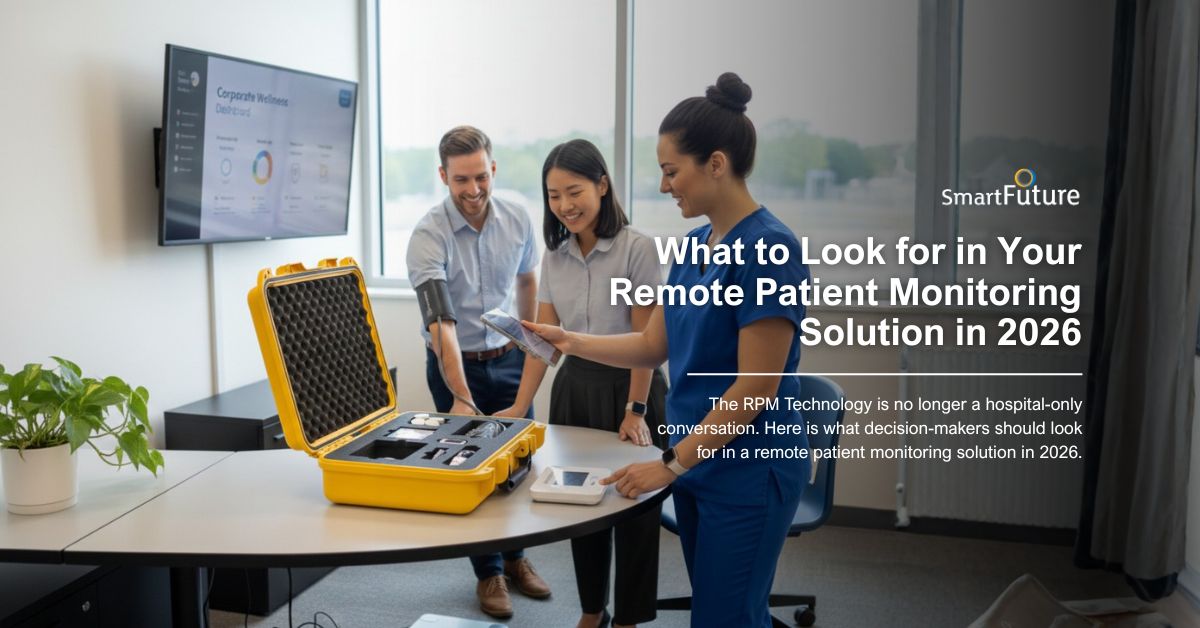
Remote patient monitoring solution is no longer a hospital-only conversation. By 2026, RPM has become infrastructure , embedded across corporate offices, nursing homes, industrial sites, schools, cruise vessels, senior housing, and hospital-at-home programs. What began as an emergency response tool during COVID-19 has evolved into a permanent layer of modern health operations.
For customers across industries , healthcare providers, employers, operators of distributed environments, and public institutions , the question is no longer whether to adopt remote patient monitoring. The question is how to choose the right remote patient monitoring solution.
Here is what decision-makers should look for in a remote patient monitoring solution in 2026.
1. Industry Fit, Not Just Clinical Fit
In 2021, RPM selection centered around hospitals managing overflow. In 2026, deployment contexts are far broader.
An offshore energy operator requires low-latency transmission over satellite.
A corporate wellness program requires aggregated dashboards without exposing individual health data.
A nursing home needs continuous monitoring and fall detection.
A cruise operator needs integration with maritime medical response.
One-size-fits-all RPM systems often fail when applied to specialized environments.
A strong remote patient monitoring solution should:
Support multiple deployment settings
Adapt to varying connectivity conditions
Allow white-label configuration
Integrate into existing workflows without friction
The solution must reflect your operational environment, not force you into a predefined template.
2. Patient Comfort Drives Data Quality
Actionable data comes from adherence.
Across industries, whether monitoring an executive with hypertension, a worker on an industrial site, or a resident in long-term care, patient comfort determines compliance. If devices are bulky, intrusive, or complicated, engagement declines.
When evaluating a remote patient monitoring system, assess:
Device weight and ergonomics
Battery life and charging simplicity
Adhesion and wearability
Ease of use for non-clinical populations
Minimal disruption to daily life
In 2026, wearable RPM devices must feel nearly invisible. The more seamlessly they integrate into daily routines, the more reliable the health data stream becomes.
3. Secure, Scalable Architecture
The volume of patient data generated by RPM programs has multiplied in recent years. Continuous glucose monitors alone can generate hundreds of data points per week. Multiply that across a population and the scale becomes significant.
Security and scalability are not optional features. They are baseline requirements.
Organizations should evaluate:
Cloud security standards
Data encryption protocols
Role-based access control
Cybersecurity compliance
Redundancy systems
Latency performance
Data must be protected not only from breaches but also from operational interruption. For industries operating in remote areas, offline redundancy and edge processing capabilities are increasingly important.
Additionally, systems must integrate with electronic health records (EHRs) using interoperable standards such as FHIR. Without seamless integration, RPM becomes a parallel system instead of an operational enhancement.
4. Real-Time vs. Batch Monitoring Capabilities
Not all environments require real-time streaming. But some do.
An industrial site monitoring cardiac irregularities in remote workers requires real-time alerts.
A postoperative discharge program may operate on daily data review cycles.
A school-based asthma program may require threshold-triggered notifications only.
A mature remote patient monitoring solution allows flexibility between:
Real-time data transmission
Scheduled data capture
Alert-based escalation
Continuous streaming
The system should align with clinical urgency and operational risk tolerance.
5. Breadth of Monitoring Devices
RPM is no longer limited to blood pressure cuffs and glucometers.
In 2026, common remote patient monitoring devices include:
ECG patches
Pulse oximeters
Blood glucose monitors
Smart inhalers
Wearable fall detectors
Smart scales with fluid retention detection
Portable ultrasound probes
Biometric fatigue trackers
Organizations should ask:
Does the platform support multi-device integration?
Can it connect with third-party FDA-cleared devices?
Does it support bring-your-own-device models?
Can devices operate without requiring patient smartphones?
A flexible remote monitoring solution should not lock you into proprietary hardware unless strategically justified.
6. Intelligent Data Filtering
One of the largest 2026 challenges is not lack of data , it is excess data.
Clinicians and administrators cannot manually review every incoming data point. Artificial intelligence and automated filtering systems are critical.
An effective RPM solution should:
Prioritize clinically relevant alerts
Learn patterns over time
Reduce false positives
Escalate only actionable insights
Without intelligent filtering, RPM increases workload instead of reducing it.
7. Regulatory Alignment and Future-Proofing
Remote patient monitoring operates at the intersection of healthcare, technology, and regulatory compliance.
Manufacturers and solution providers must:
Ensure device classification compliance
Track evolving regulatory guidance
Align with regional reimbursement frameworks
Maintain transparent documentation
In 2026, reimbursement models continue to evolve. Value-based care and outcome-driven payment structures increasingly rely on RPM-generated data.
Your partner must anticipate regulatory shifts, not react to them.
8. Integration Into Existing Systems
Remote patient monitoring should supplement , not replace , your operational ecosystem.
Questions to consider:
Can it integrate with existing hospital systems?
Does it support independent diagnostic testing facilities?
Will it require additional hardware in facilities?
Can it coexist with other vendors’ devices?
The most effective RPM deployments enhance existing infrastructure rather than disrupt it.
9. Proven Leadership and Long-Term Partnership
Technology evolves quickly. Partnerships endure.
Beyond features and specifications, organizations should evaluate:
Leadership stability
Acquisition risk
Alignment of vision
Track record in your industry
Longevity of previous partnerships
In the past few years, major acquisitions in the RPM space have reshaped vendor landscapes. While consolidation can strengthen capabilities, it can also shift strategic priorities.
Choosing a partner in 2026 requires assessing whether their roadmap aligns with your long-term objectives.
10. Support and Training Infrastructure
RPM programs succeed when both clinicians and end-users feel confident.
A robust solution must include:
24/7 technical support
Dedicated account management
Onboarding and training programs
Ongoing optimization reviews
Organizations deploying RPM across distributed environments cannot afford downtime or confusion.
The 2026 Reality: RPM as Operational Infrastructure
The early pandemic years accelerated RPM adoption. The years that followed cemented it.
Government reimbursement structures expanded. Clinician shortages intensified. Rural healthcare gaps widened. Corporate wellness became strategic. Industrial safety standards tightened. Patient expectations shifted permanently toward convenience.
Remote patient monitoring is now embedded in:
Hospital at Home programs
Corporate health initiatives
Nursing home oversight
Offshore safety protocols
Cruise medical operations
School health systems
Residential senior housing
The right remote patient monitoring solution is not merely a device network. It is a strategic operating layer.
Choosing Wisely
At SmartFuture, we believe organizations in 2026 must approach RPM selection with a systems mindset.
Great technology is necessary. But it is not sufficient.
The solution must align with your environment, scale with your growth, secure your data, integrate with your systems, empower your users, and support your long-term strategy.
Remote patient monitoring is here to stay. The only variable is how intelligently it is deployed.
Contact SmartFuture now to learn how our RPM platform and Direct Home Medical Kit solutions can empower your organization's expansion.
Related articles
5 Reasons People Are Choosing SmartFuture MediKit
As healthcare systems evolve, people want solutions that are connected, portable, and simple to operate on site.
How AI in Healthcare Changes Patient Care
AI in healthcare is becoming essential as providers face growing and complex challenges.
Using RPM to Improve Athlete Performance
Remote patient monitoring is not only for chronic disease. Sports programmes use the same connected vitals stack for recovery and readiness.